By Julia Kellman, Professor Emerita of Art Education, University of Illinois at Urbana-Champaign
Fred Easker’s Iowa landscapes, predominantly of Northeast and East Central Iowa, reflect the artist’s lifelong intimacy with these areas—the light that washes over them, the sky that encloses them, and the land that forms their steep bluffs, curving fields, and rolling hills.
Ever since his childhood summers spent on the farm of family friends near Cedar Rapids, Easker, a life-long Midwesterner, has been steeped in the weather, moods, and shapes of Iowa. His paintings reflect long familiarity as he portrays a particular part of his visual world; they illuminate how a location feels to him as well as how it appears, reflecting what he knows from his earliest experiences.
The often long narrow shape of his canvases also repeats his vision of Iowa as a prairie place edged with river bluffs and valleys and emphasizes his understanding not only of the land’s expansiveness but also its long calligraphic horizon.
Easker’s handling of atmosphere is reminiscent of Vermeer’s ability to paint light as it fills a room and bathes the objects it encompasses in silver light. In Easker’s paintings, the light, softened by Iowa’s humid air, also exists as a visible vital part of a scene, creating the forms of the plowed and planted earth, the towering sky, the delicate etched branches of trees and stalks of grass, at the same time that it is the luminous matrix that contains them all.
Though Easker’s world is uninhabited by people, buildings and structures exist in some images—farm buildings in the background of rolling hills, a deserted house on a high ridge, the Blackhawk Bridge over the Mississippi River at Lansing where Easker has a studio and gallery. These objects are as entrancing as Esker’s painting of a bend in the Cedar River in autumn, a copse of trees leaning over a frozen stream in Ostradock, his many fields of corn in the fragile light of spring, for they invite the viewer to contemplate them as part of the environment rather than an intrusion into it.
Motionless, timeless, rich with color and the carefully observed visual complexity of Iowa’s natural world, Easker’s radiant landscapes describe a place where time stands still, when, just for a moment the wind dies down, and when the beauty of what he sees is ours to share and cherish with him.
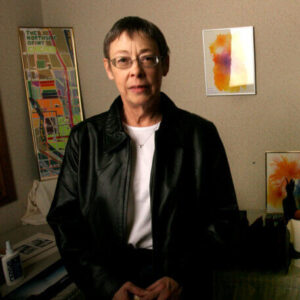
Julia Kellman
Professor Emerita Art Education
School of Art and Design
University of Illinois at Urbana Champaign
Author of:
- Autism, Art, and Children: The Stories We Draw (Bergin & Garvey, 2001)
- Stories of the Hand: Art Education and the Culture of Ability (University of Illinois Press, 2003)